
Charts of the Week
Charts of the week from 12 to 16 January 2026: activity in construction, number of persons in employment, current account of the balance of payments and other charts
Growth in the value of construction put in place strengthened markedly from the second quarter of 2025 onwards; over the first eleven months it was one tenth higher year-on-year. The number of persons in employment has stagnated for several months (seasonally adjusted), and, in the first eleven months of 2025, remained 0.4% lower year-on-year. The current account surplus amounted to EUR 2.4 billion in the first 11 months of 2025, which is 0.6 billion lower than in the same period of 2024. The volume of road and rail freight transport, which had been declining from 2022, increased slightly in the third quarter of 2025. Industrial electricity consumption in December was 0.4% lower than a year earlier despite an additional working day, while household consumption was 2.2% higher.
Activity in construction, November 2025
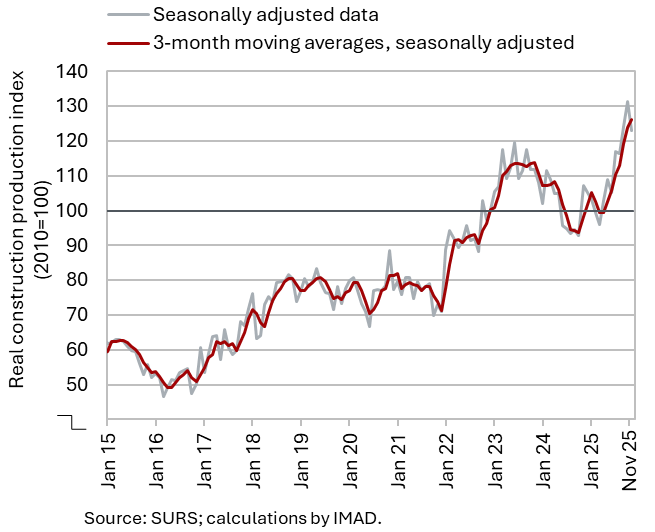
The value of construction put in place declined slightly in November, while remaining significantly higher year-on-year. Following a decline in the first quarter, construction activity strengthened over the remainder of the year, amid monthly fluctuations. In November, it decreased by 6% (seasonally adjusted), but was still significantly higher (by 12%) than a year earlier. Overall, the value of construction put in place in the first eleven months of last year was 10% higher than in the same period a year earlier. The largest increase was recorded in the construction of non-residential buildings and in specialised construction activities (15% in both), activity in civil engineering also rose (7%), while construction of residential buildings remained broadly unchanged (1%).
The construction confidence indicator reached a year-and-a-half high in November, before edging down slightly in December. Companies generally assess new orders as normal. The main constraint continues to be a shortage of skilled labour. Only about one tenth of companies cite insufficient demand as a limiting factor, indicating that the construction sector is currently not facing significant demand-side pressures but is instead constrained by supply-side factors.
Number of persons in employment, November 2025
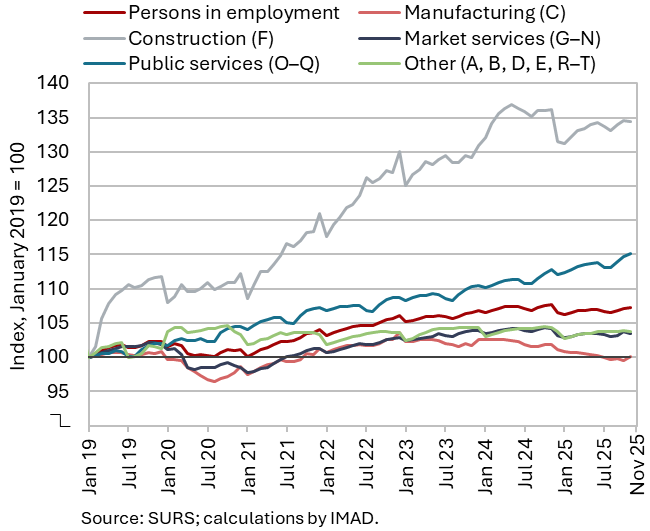
The number of persons in employment remained similar in November to previous months (seasonally adjusted) and was 0.4% lower year-on-year. The number of employees declined year-on-year (–0.6%), while the number of self-employed increased (1.3%). The sharpest year-on-year decline in the number of persons in employment was recorded in administrative and support service activities (–2.1%), mainly due to a decrease in employment agencies, followed by manufacturing (– 1.8%), and information and communication (– 1.3%). The number of persons in employment continued to increase on a year-on-year basis in public service activities, particularly in human health and social work activities (up 3.4%). The number of foreign citizens in employment increased by 1.5% year-on-year in November, while the number of Slovenian nationals in employment declined by 0.7%.
In the first eleven months of 2025, the number of employed persons remained 0.4% lower year-on-year. The structure of the decline by activity was similar to that in November.
Current account of the balance of payments, November 2025
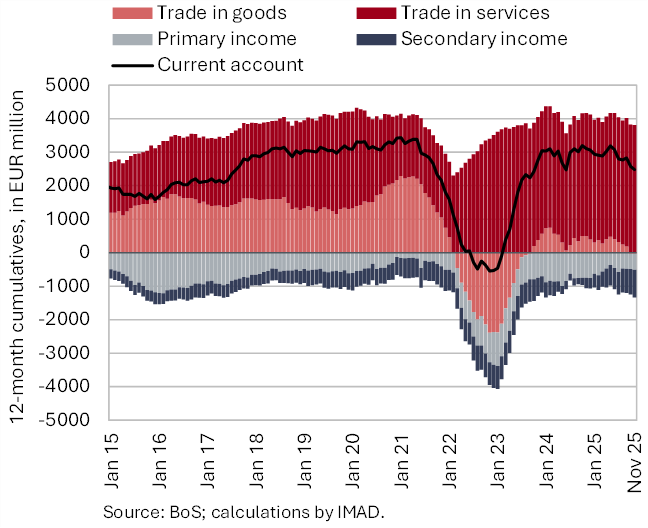
The current account surplus amounted to EUR 2.4 billion in the first 11 months of 2025 and was EUR 0.6 billion lower than in the same period of 2024. The decline was mainly driven by a wider secondary income deficit, primarily due to lower receipts from the EU budget. Amid faster growth in goods imports than exports, the goods balance also contributed to the reduction in the surplus. The services surplus, however, increased, most notably in travel services (growth in tourism receipts from foreign visitors exceeded the growth in expenditure by domestic residents on travel abroad). The surplus in insurance services also increased markedly, as a Slovenian insurance company expanded its business activities and related services in the Italian motor insurance market. The primary income deficit was lower, mainly due to smaller net outflows from equity income (dividends and profits) and higher earnings of Slovenian workers from employment abroad.
Electricity consumption by consumption group, December 2025
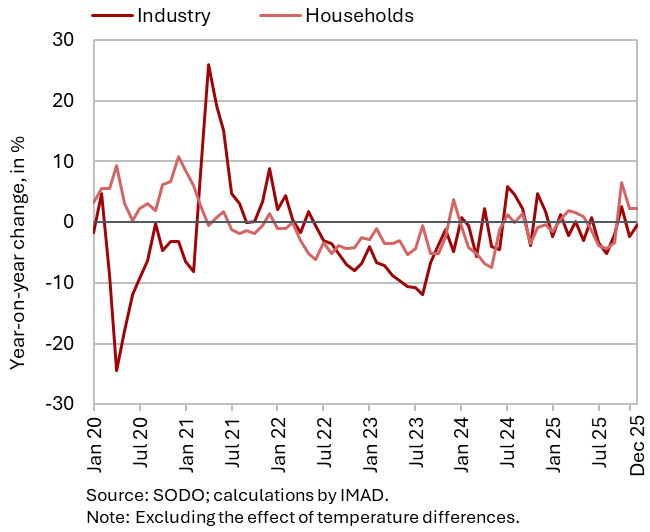
The December data indicate a year-on-year decrease in industrial electricity consumption. Despite one working day more in December 2025, electricity consumption was 0.4% lower than in December 2024. By contrast, household electricity consumption increased by 2.2% year-on-year.
Road and rail freight transport, Q3 2025
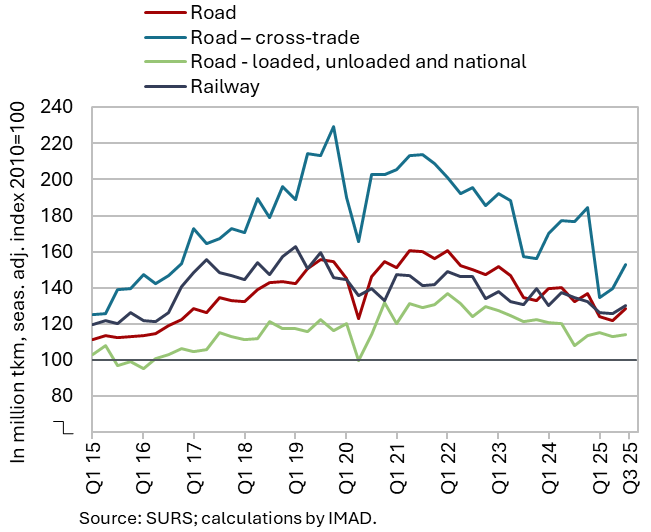
The volume of road and rail freight transport, which had been declining from 2022, increased slightly in the third quarter of 2025. Overall, the volume of road transport increased by 5% on a quarterly basis (seasonally adjusted), but remained lower year-on-year (by 3%). In road transport performed by Slovenian vehicles, the volume of cross-trade increased markedly for the second consecutive quarter (following a sharp decline in the first quarter), while the volume of transport at least partly taking place on Slovenian territory (exports, imports and national transport) increased only modestly. The share of cross-trade in total transport was 43%, which was 5 p.p. lower than before the COVID-19 pandemic. Rail freight transport on Slovenian territory increased by 3% in the third quarter (seasonally adjusted), but decreased by 4% year-on-year. In 2025, the volume of road and rail freight transport was the lowest since 2016.