
Charts of the Week
Charts of the week from 21 to 25 September 2026: economic sentiment, Slovenian industrial producer prices, average gross wage per employee and real estate
Economic sentiment remained broadly unchanged in September and was higher than a year earlier and above its long-term average. Slovenian industrial producer prices rose by 3.5% year-on-year in August, the highest growth rate in the past three years, i.e. since the energy crisis. Growth in the average gross wage remained relatively high, at 7.6% in July. In the public sector, wage growth strengthened further, driven by the payment of the third instalment of the basic salary increase in June. Year-on-year growth in prices of existing dwellings remained high in the second quarter, while the number of transactions was slightly lower. Prices of newly built dwellings were also lower year-on-year, amid a substantial decline in transactions.
Economic sentiment, September 2026
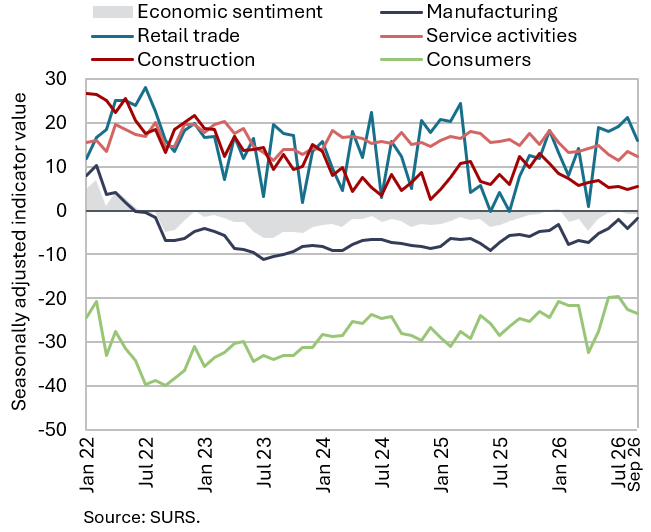
Following a decline in August, the economic sentiment indicator remained largely unchanged in September, thus staying above its level a year earlier and its long-term average. On a monthly basis, only the confidence indicator in manufacturing increased, although it remains below its long-term average. The other confidence indicators mostly declined month-on-month, while the confidence indicator in construction, which has been lower year-on-year since the end of the first quarter of 2026, was the only one to remain unchanged. The confidence indicator in services has also been lower year-on-year since the beginning of the year.
Slovenian industrial producer prices, August 2026
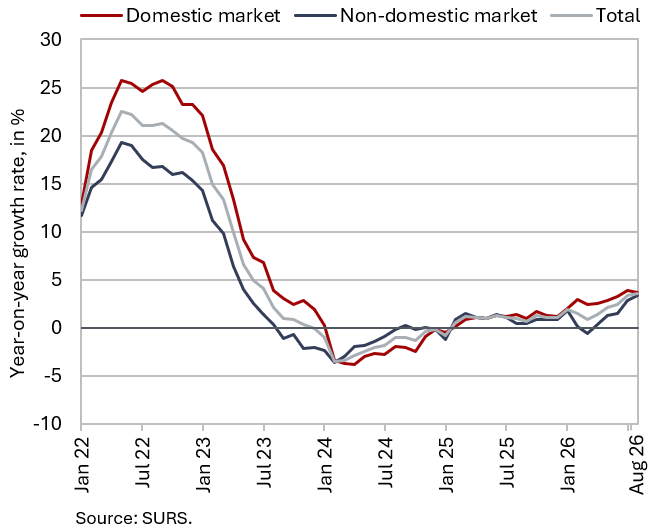
Year-on-year growth in Slovenian industrial producer prices continued to increase in August (to 3.5%), reaching the highest level in the past three years. Prices were higher year-on-year across all industrial groups, with growth driven mainly by intermediate goods prices, which rose by 5.8%, particularly due to a 14.9% increase in prices in the manufacture of basic metals. Prices in this activity have risen by 9.0% over the last four months. Price growth in the other main industrial groups was less pronounced. Prices of energy and capital goods were 2.6% and 2.4% higher year-on-year, respectively, while growth in consumer goods prices slowed to 1.0%. The gap between price growth on the domestic market (3.7%) and on foreign markets (3.4%) narrowed further in August. Prices of products sold on euro area markets are rising faster (3.9%), while prices on non-euro area markets are following with a slight lag (2.0%).
Average gross wage per employee, July 2026
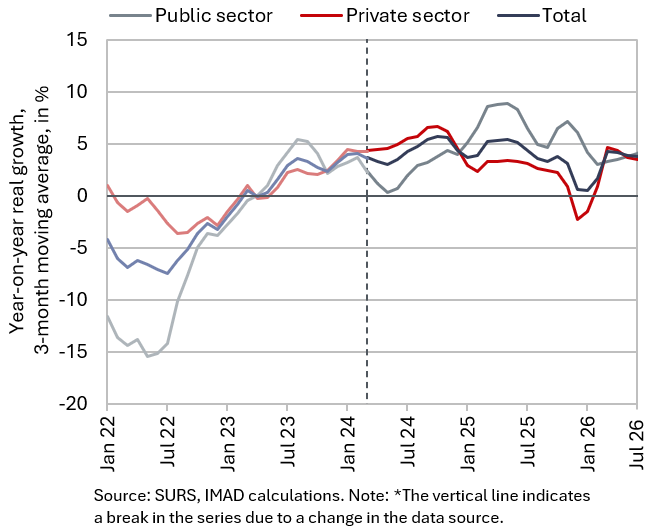
Year-on-year nominal growth in the average gross wage was slightly lower in July (7.6%) than in June, but remained relatively high. This was largely attributable to stronger wage growth in the public sector (8.4%), related to the payment of the third instalment of the basic salary increase (paid in June). In the private sector, year-on-year wage growth also remains relatively high (7.0% in July), amid stronger economic growth and labour shortages. Across activities, wage growth was highest in construction (9.2%).
In the first seven months of 2026, the overall average gross wage increased by 7.3% in nominal terms (4.2% in real terms) – by 7.1% in the public sector (4.0% in real terms) and by 7.2% in the private sector (4.1% in real terms).
Real estate, Q2 2026
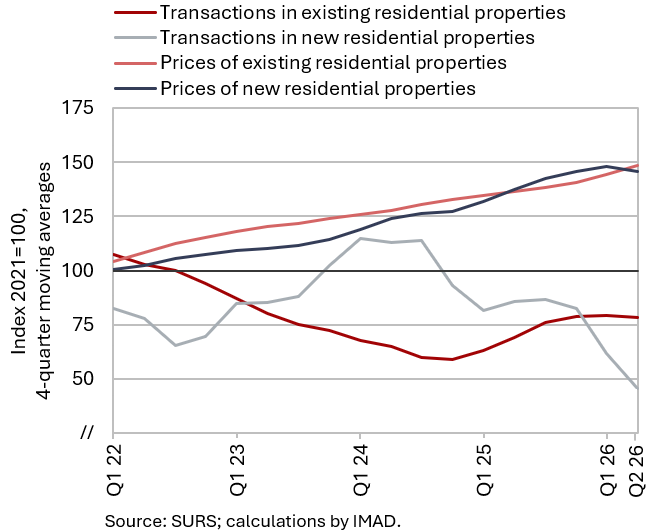
Year-on-year growth in dwelling prices remained high in the second quarter, while the number of transactions was lower than a year earlier. Following average price growth of 7.3% last year (broadly similar to that recorded in 2023 and 2024), growth in dwelling prices accelerated to 9.3% in the first quarter of 2026 and remained largely unchanged in the second quarter (9.1%). Prices of existing dwellings were 12.2% higher year-on-year in the second quarter, while the number of transactions fell by 4.4% from a year earlier, when it had increased considerably following several years of decline. Sales of newly built dwellings declined even more markedly year-on-year, by 64.1%, although they accounted for only a small share (3%) of all transactions. Their prices were also lower year-on-year (by 5.8%).