
Charts of the Week
Charts of the week from 6 to 9 January 2026: unemployment, production volume in manufacturing and government bond
In December, the number of unemployed persons remained unchanged month-on-month (seasonally adjusted), but slightly exceeded the very low level recorded in December 2024. The number of long-term unemployed and older unemployed persons continued to be lower than a year earlier, whereas the number of unemployed young persons was nearly one tenth higher. Manufacturing output increased slightly month-on-month in November. Over the first eleven months, it remained lower year-on-year; among the major activities, the year-on-year decline was largest in the manufacture of motor vehicles, trailers, semi-trailers and other transport equipment and in the metal industry. The yield to maturity on the Slovenian government bond declined in the fourth quarter of last year, as did the spread to the German bond (to 33 basis points), which was at its lowest level since 2007.
Unemployment, December 2025
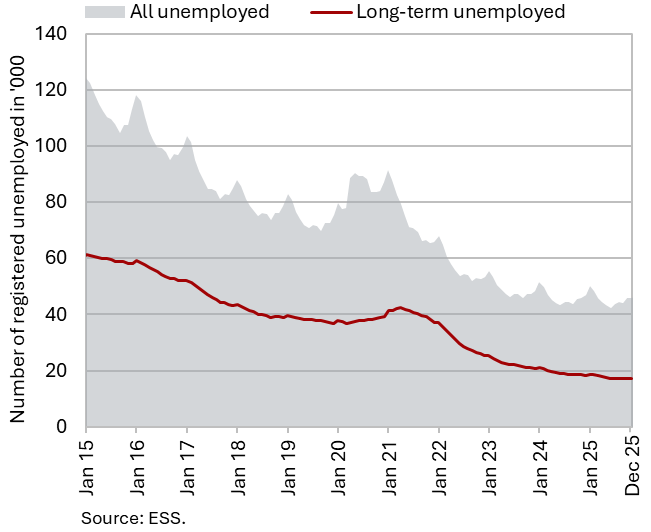
In December 2025, the number of unemployed persons (seasonally adjusted) remained broadly unchanged on a month-on-month basis (–0.1%). According to original data, 47,177 people were unemployed at the end of December, representing a 3% increase compared with the end of November. This increase largely reflects seasonal factors, notably a higher inflow into unemployment following the expiry of fixed-term employment contracts. On a year-on-year basis, unemployment increased slightly (by 0.3%). The year-on-year declines in long-term unemployment (–5.6%) and in unemployment among persons aged 50 and over (–5.3%) were somewhat smaller than in previous months. The number of unemployed young persons (15–29 years) has been higher year-on-year since the end of 2024 (in December, there were 10,944 unemployed young people, representing a 9.4% year-on-year increase).
In 2025, on average 45,410 persons were registered as unemployed, 1.2% fewer than a year earlier.
Production volume in manufacturing, November 2025
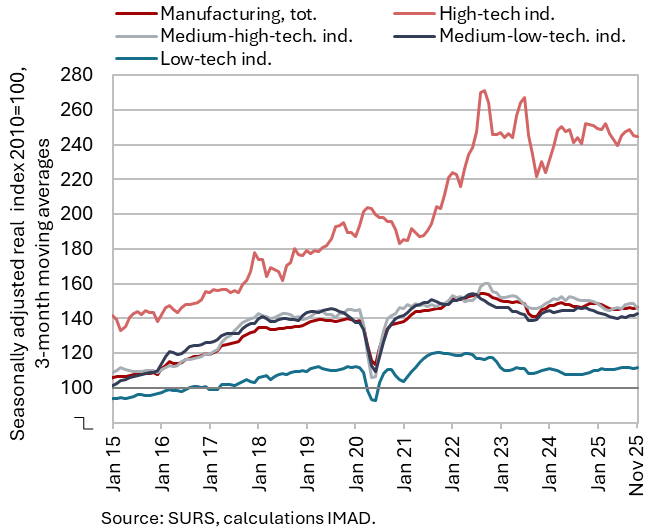
Manufacturing production strengthened somewhat month-on-month in November, while over the first eleven months of 2025 it remained lower year-on-year. After contracting at the beginning of 2025, manufacturing output remained largely unchanged. On average in October and November, it stood at the level of the third quarter; only output in medium-low-technology industries was slightly higher (owing to a weak August). In the remaining three groups of industries, output declined slightly after increasing in the third quarter (all seasonally adjusted). In the first eleven months, total output was 1.1% lower year-on-year (working-day adjusted), while only output in low-technology industries increased (by 2.5%, working-day adjusted). Compared with the same period of 2024, the largest increases were recorded in other manufacturing, food production and the wood industry. Output in the leather industry was one quarter lower. In other groups of industries by technological intensity, output in most industries was lower year-on-year in the first eleven months (with the exception of the manufacture of ICT equipment and the repair and installation of machinery and equipment). The sharpest decline was recorded in the manufacture of motor vehicles, trailers, semi-trailers and other transport equipment (by around 9%), while output in the metal industry was lower by around 5%.
Government bond, Q4 2025
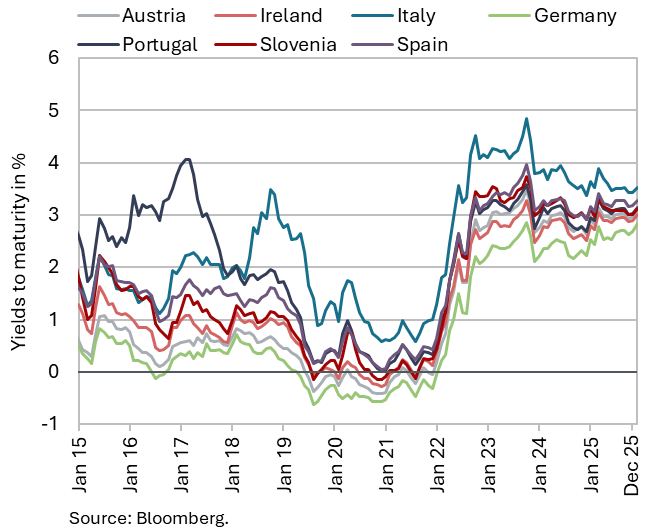
The yield to maturity on Slovenian government bonds declined by 4 basis points in the fourth quarter of 2025, to 3.05%. The spread to the German bond narrowed by 6 basis points (to 33 basis points), the lowest level since 2007. In the absence of inflationary pressures in the fourth quarter of last year, the ECB did not change its key interest rates.